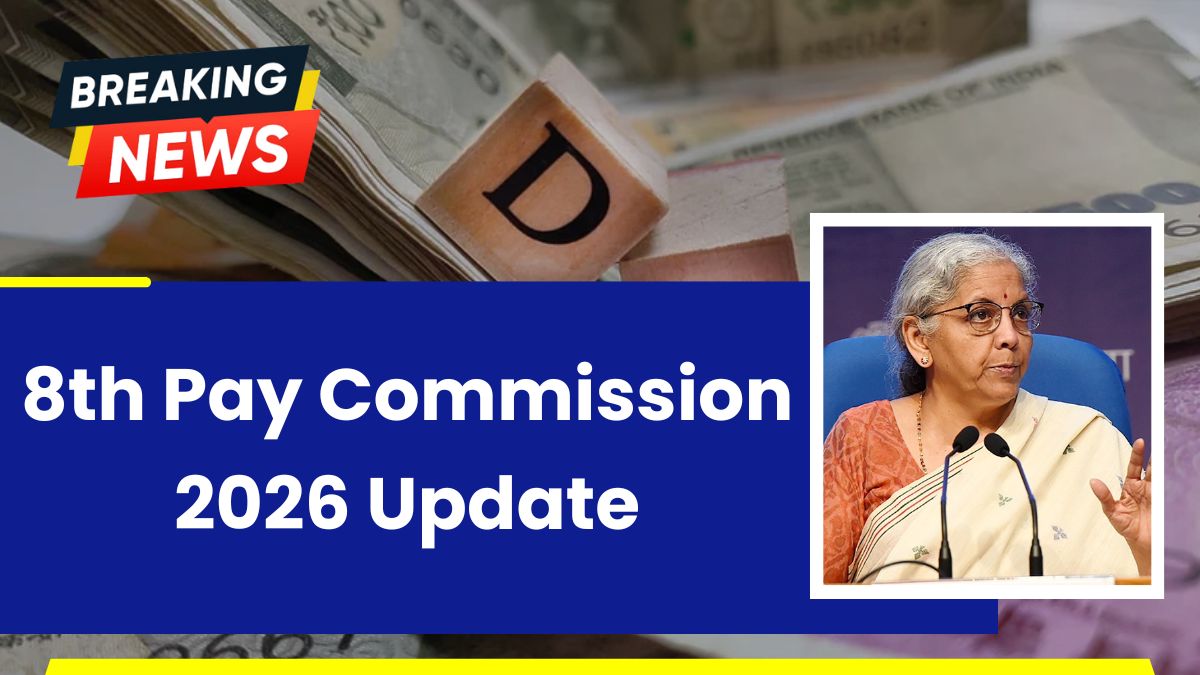
8th Pay Commission Update 2026 : The 8th Pay Commission is already becoming a hot topic among central government employees and pensioners, even though implementation is still some time away. Whenever a new pay commission is discussed, it naturally grabs attention because it directly affects monthly income, retirement benefits, and long-term financial security. This time, one of the biggest talking points is the possible merger of Dearness Allowance (DA) with Basic Pay. If this happens, it could reshape how government salaries are structured for years to come.
What Exactly Is Dearness Allowance
Dearness Allowance, or DA, was originally introduced as a way to help employees deal with rising prices. Inflation slowly eats into the value of money, and DA acts as a cushion by increasing pay in line with the cost of living. Over the years, DA has been revised multiple times and has grown into a significant part of overall salary. For many employees today, DA is no longer a small add-on but a major component of their monthly income.
Why the DA Merger Idea Is Gaining Support
The main reason behind the proposed merger is that DA has grown so large that it no longer makes sense to treat it as a temporary or separate element. Experts and employee unions often argue that once DA crosses a certain percentage of Basic Pay, it should be merged. This resets the calculation and brings more stability to the pay structure. The idea being discussed for 2026 is to add the existing DA to Basic Pay and then restart DA calculations from zero on the new basic amount.

How the Merger Would Actually Work
If the merger happens, the current DA percentage will be added directly to Basic Pay. For example, if someone’s basic salary is ₹30,000 and DA is 50 percent, the new Basic Pay could become ₹45,000 after the merger. After that, future DA increases would be calculated on this higher base. This change might look simple on paper, but its ripple effect would be seen across multiple salary components that are linked to Basic Pay.
Impact on Allowances and Monthly Take-Home Pay
One big reason employees are excited about this proposal is that many allowances are calculated as a percentage of Basic Pay. These include House Rent Allowance (HRA), transport allowance, and sometimes special duty or location-based allowances. When Basic Pay increases due to the DA merger, these allowances automatically go up as well. This means the total salary doesn’t just rise slightly—it can see a noticeable jump, making monthly finances a bit more comfortable.
Simpler Salary Slips and Better Transparency
Right now, government salary slips can look confusing, especially for those who are not familiar with how pay structures work. With DA being revised regularly, figures keep changing and sometimes make it hard to understand the real base salary. Merging DA with Basic Pay can simplify things. Employees would see a clearer structure, and it would be easier to understand how their pay is built up. This could also reduce calculation errors in payroll systems.

A Major Boost for Pensioners
Pensioners may benefit even more than serving employees. Pensions are generally calculated as a percentage of the last drawn Basic Pay. If Basic Pay increases due to the DA merger, pensions will also rise permanently. This is especially important for retirees who rely mainly on pension income to cover medical expenses, daily living costs, and family responsibilities. A higher fixed pension offers more financial comfort and stability during retirement years.
Effect on Retirement Benefits and Lump Sum Payments
The DA merger could also increase other retirement-related benefits. Gratuity, leave encashment, and commutation value are all linked in some way to Basic Pay. When the basic figure rises, these one-time payments at the time of retirement can also go up. For employees nearing retirement around the time of implementation, this could make a significant difference in their final settlement and long-term savings.
Government’s Financial Challenge
Of course, such a move doesn’t come without cost. When salaries and pensions rise for millions of employees and retirees, the government’s expenditure also increases sharply. This means the authorities have to balance employee welfare with budget discipline. There is a chance that the merger, if approved, could be rolled out in phases or combined with other reforms to manage the financial load more smoothly.

Long-Term Benefits for the Pay Structure
Despite the financial pressure, many experts believe the merger makes sense in the long run. It aligns pay structures more closely with real economic conditions and prevents DA from becoming an oversized, separate element. Over time, this can make future pay revisions more systematic and less complicated. It also builds confidence among employees that their salaries are keeping pace with inflation in a more permanent way.
What Employees and Pensioners Should Keep in Mind
While the discussions are encouraging, it’s important to remember that nothing is final yet. Pay commission recommendations go through several stages, including review, approval, and official notification. Timelines can change, and the final formula may differ from what is currently being talked about. Still, the possibility of DA merging with Basic Pay has created hope for better income security and improved retirement benefits.
Looking Ahead to 2026
As 2026 approaches, more clarity will likely emerge about the structure and recommendations of the 8th Pay Commission. Employees and pensioners should keep an eye on official announcements rather than relying only on rumors or social media forwards. If the DA merger becomes reality, it could mark one of the most important changes in government salary history, affecting pay, pensions, and allowances for years to come.

Disclaimer
This article is intended for general informational and educational purposes only. It is based on ongoing discussions, expectations, and publicly circulating reports related to the 8th Pay Commission. No final decision has been officially confirmed by the Government of India at the time of writing. Salary structures, DA merger details, and pension revisions will depend entirely on formal government notifications. Readers are advised to verify updates through official sources before making financial or retirement-related decisions.